Why “Just One Small Change” Can Become a Big Problem in Software Projects
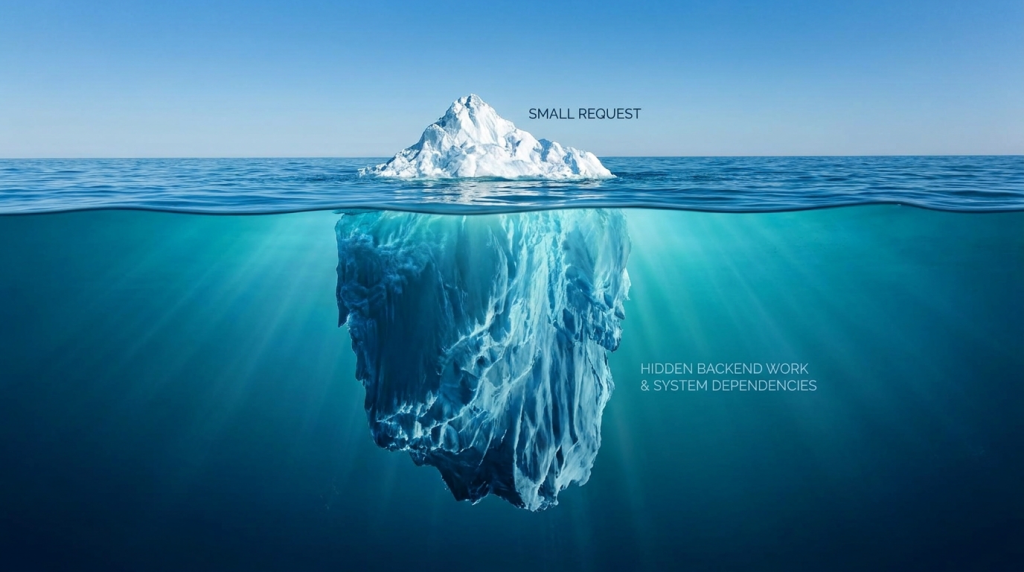
“Can we make just one small change?”
If you have worked on client projects for a while, I’m sure you have heard this question many times.
Sometimes, the requested change really is small. A label needs to be changed, a button needs to move, or an existing field needs a minor adjustment.
But sometimes, what looks like a small change from the outside can become a much bigger task once you start looking at the system behind it.
Over the years, I have learned that the size of a client’s request doesn’t always tell us the size of the work involved.
The Problem With “Small Changes”
Let’s imagine a client asks:
“Can we add one more option to this form?”
At first, it sounds simple.
But then you discover that the form is connected to an API. The API stores the value in the database. That value is used somewhere else to generate an email. Another part of the application uses the same data to calculate something.
Suddenly, the change is no longer just about adding a field.
It might involve:
- Frontend changes
- Backend logic
- Database changes
- API updates
- Validation
- Email or notification logic
- Existing integrations
- Testing and regression checks
The visible change may be small, but the impact can be much larger.
A Feature Is Rarely Completely Isolated
One of the things I have learned from working on different types of projects is that software is connected.
A button may trigger an API request.
That API request may update a database record.
That database record may be used by another module.
That module may affect an email, report, calculation, or another part of the application.
This is why experienced developers don’t always start coding immediately after hearing a requirement.
Sometimes the first step is simply understanding what the change touches.
Existing Code Has a History
Another challenge appears when working on an existing project.
You may look at a piece of code and think:
“Why was this written this way?”
It might not look like the cleanest solution.
But there may be a reason behind it.
Perhaps an old client requirement depended on it. Maybe another system uses that particular data structure. Maybe changing it previously caused a problem.
This is one reason I try to avoid making assumptions when working with an unfamiliar codebase.
Before changing something, I want to understand its role in the system.
You don’t necessarily need to understand every line of the project. But you should understand enough of the surrounding context to make a safe change.
The Hidden Cost of a Small Change
When someone estimates a task, it’s easy to think only about development time.
For example:
“This should take one hour.”
But the actual work may look more like:
Understand → Develop → Test → Fix → Regression Test → Deploy → Verify
The coding itself might take one hour.
The testing and verification might take another two.
And if the change affects an existing feature, the risk of regression also needs to be considered.
This doesn’t mean every small request should become a large project.
It simply means we should understand the impact before estimating the effort.
How I Approach Small Changes
Before making a change, I usually try to answer a few simple questions.
1. Where is this functionality currently used?
I want to know whether the feature is isolated or shared across multiple areas.
2. What depends on it?
A change to one component can affect other components, APIs, database structures, or integrations.
3. Is there any existing business logic involved?
This is particularly important in client projects.
Sometimes something that looks like a technical implementation actually represents a business rule.
4. What could break?
I try to identify the existing functionality that needs to be tested after the change.
5. Is this really a small change?
Sometimes the answer is yes.
Sometimes it isn’t.
And that’s perfectly fine.
The important thing is to identify that before promising a delivery time.
Communicating This With Clients
This is where technical knowledge and communication become equally important.
If a client asks for a small change, simply saying:
“That’s complicated.”
doesn’t really help.
Instead, I prefer to explain what makes the change larger.
For example:
“The visible change is small, but this value is currently used in three other areas of the system. I’ll need to update those areas and test the existing functionality to make sure nothing is affected.”
This gives the client context.
More importantly, it builds trust.
Clients don’t necessarily need to understand the technical details. But they should understand why something that looks small may require more time.
Don’t Overengineer Every Change
There is another side to this discussion.
As developers, we can sometimes go too far in the opposite direction.
Not every small request needs a complete refactoring or a new architecture.
If a simple change can safely be implemented within the existing structure, sometimes that’s the right solution.
The goal isn’t to make every change complicated.
The goal is to understand the consequences before making the change.
That’s an important distinction.
Small Changes Can Also Be Opportunities
There is one more thing I try to keep in mind.
Sometimes a small request exposes a larger problem in the system.
For example, if adding one simple option requires changes in five different places, that might be a sign that those parts of the system are too tightly coupled.
I don’t necessarily refactor everything immediately.
But I take note of it.
Maybe the current change should remain small, while the larger architectural improvement can be planned separately.
This helps avoid turning every client request into an unexpected rewrite.
What I Have Learned
After working on software projects for many years, one lesson has become very clear to me:
The size of a request is not always the size of the work behind it.
A good developer doesn’t just ask:
“How can I implement this?”
They also ask:
“What will this change affect?”
That small difference in thinking can prevent unexpected bugs, unrealistic estimates, and unnecessary stress for both the development team and the client.
So the next time someone says:
“It’s just a small change.”
Maybe it is.
But before writing the first line of code, take a moment to look underneath it.
You might discover that the change is small.
Or you might discover the real work.